Seven Days at Sea: Why You Cross Instead of Fly
There is no flight that competes with the feeling of crossing the Atlantic by sea. Here’s what a Cunard transatlantic crossing is actually like — from someone who’s done it.
We booked the Cunard transatlantic—Queen Mary 2, sailing January 3rd from Brooklyn to Southampton—and my husband kept saying, “This is going to be our first legit vacation in years.” He was right. We were due. Chase travels for work; I travel solo. It’s the occupational hazard of this particular job. We are rarely in the same destination at the same time, and almost never without an agenda. This was the exception.
The logic of it doesn’t make sense if you’re thinking about arrival. Seven days at sea when you could fly in seven hours? Why would anyone do that? The answer is that you’re not paying for seven days of ocean. You’re paying for a crossing—for the ritual of it, the deliberate slowness, the fundamental shift in how you move through the world. You’re paying to arrive, not to get there.
New York
We arrived in lower Manhattan on January 1st—well-rested, deliberate, having missed the chaos of the night before entirely. New York City on New Year’s Eve sounds like its own kind of endurance sport. We wanted none of it. The city had exhaled. Quieter than we’d expected, slightly recuperating, still beautiful, still unmistakably itself. We ate well. We saw Audra McDonald in Gypsy—one of those performances that reminds you exactly why you love the theater—and walked Central Park in the cold and stomped around DUMBO. Two days of exactly that: no agenda, no rushing, just a city at rest and us grateful to be in it. An exhale before the crossing.
Sailing Out of Brooklyn
January 3rd. We walked to the Brooklyn Cruise Terminal—the original Cunard terminal, the one that still feels like a proper sailing day instead of a gate assignment—and boarded the Queen Mary 2. We stood at the rail as Lady Liberty passed off the starboard bow, the Manhattan skyline pulling away behind her. That’s been the view from this deck for over a hundred years. You feel it.
I booked us in an inside cabin—the sensible starting point on any ship I haven’t sailed before. My practice is to book the baseline on a first sailing: understand what’s included at entry level, what the ship offers beyond it, and what the upgrade conversation actually looks like. An inside cabin on the QM2 is not a hardship. The room is well-proportioned, the bed is proper, and the ship has so many places to be that your cabin is primarily for sleeping—which, on a crossing, is exactly what you want. I sleep well in pitch black. The Atlantic rocked us both under within minutes each night. Our stateroom attendant made the whole thing impeccable without ever announcing himself—the kind of service you only notice in retrospect.
The Atlantic
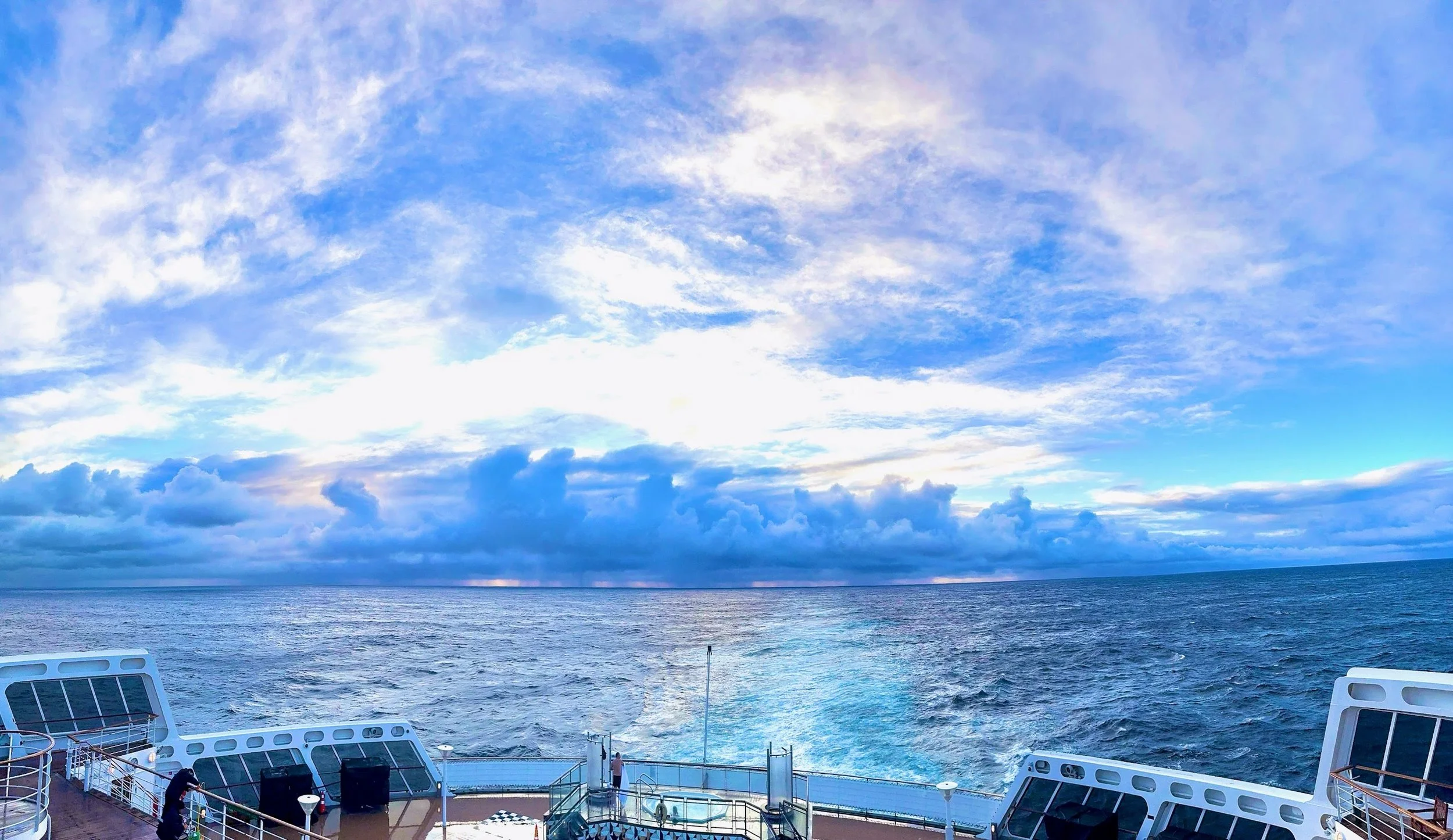
The Atlantic in January is grey. Not dramatically grey, not stormy-grey—just a relentless, total grey that folds the sky and the water into the same continuous thing. Rain most days on our crossing. Snow for much of it—real snow, dusting the promenade, collecting on the rails. Swells that rolled under the hull at a slow, even frequency you eventually stopped registering. What surprised me was the ship herself. You expected to feel the crossing, and you did—out on the promenade, spray on your face, the wind doing what Atlantic wind does. But inside, the QM2 was impervious. Warm corridors, warm bars, warm dining rooms. The wildness outside made the warmth inside feel earned in a way that a hotel room never does.
Somewhere in the middle of it, the captain announced our coordinates over the PA. We were passing over the site where the Titanic sank. The ship went quiet. People gathered at the rail. There are moments at sea that remind you the ocean has a history, and you’re passing through it.
The People You Find
This was not a gay cruise, but, Cunard hosts LGBTQ+ gatherings at the Commodore Club. I expected to find a handful of family. What I walked into was standing room only—many queens aboard that old Queen, a room full of travelers who understood exactly why this ship, this pace, this particular choice. Our table grew each night and the gatherings got louder and warmer as the crossing progressed. One evening, after we spilled out onto the promenade, a rainbow appeared over the Atlantic—just appeared, nobody arranged it. Talk about welcoming.
The music on this ship is something else entirely. Every bar and lounge has its own live programming, and the standard is genuinely high—something for every taste, every mood, every hour of the evening. One night Zo Blow played in the theater—a brass musician who gave me a whole new appreciation for what a trombone can do. When he opened with “Love on Top,” Beyoncé rendered in brass, I felt it in my chest. The string trio in the Britannia delighted us with more classic fare. And then there was the crooner. I won’t go into it, except to say the man had enough talent to make Chase and me both briefly forget we were married. Big voice. Big talent.
What You Eat
The Britannia Restaurant is the main dining room—and it earns the name. Two-story ceilings, ornate fixtures, a room designed to make you feel the occasion. Smart casual most nights; two formal nights per crossing, and our crossing called for black and white and masquerade. The pomp and circumstance is genuinely fun if you’re up for it—worth embracing at least once. If you’re not, a handful of more casual outlets exist onboard for those who’d rather not pack the sequins. The menu leans British and classical—proper technique, daily options that rotate, we never had the same dish twice—the kind of cooking that respects the room it’s served in. The same table, the same waitstaff, the same rituals—breakfast, lunch and dinner, day after day—until by mid-crossing you have a relationship with your section that you’ll miss when you’re gone.
Afternoon tea is a tradition aboard the QM2, and it’s treated like one. White-gloved waiters parading in with the full service—sandwiches, scones, clotted cream, proper pastries, a string quartet—this is the ceremony in full. There are ship experiences that feel performative. This one feels genuine every time. We upgraded to the Laurent-Perrier champagne tea as well, which is not included in the base fare. It’s absolutely worth the decision.
None of the specialty dining is included in the crossing fare—consider these worthwhile additions to your onboard budget. We ate at Coriander, the Indian restaurant, and Chase and I agreed it was one of our best meals ever at sea. We would go back without a second thought. We didn’t make it to Bamboo, the Asian fusion option, but heard good things from tablemates who had.
The Verandah is the ship’s steakhouse, and it earns every word I will spend on it. We did the Lunch & Learn—the sommelier leading a dedicated food and wine event that was one of the best pairings experiences I’ve had anywhere. Not just because the wines were excellent, but because he made you understand them—tracing the logic between what’s in the glass and what’s on the plate with a fluency that made four courses and eight wines feel like a conversation rather than a curriculum. Worth every dollar. We came back for dinner. We had to. Because The Verandah has rolls. Not good-for-a-ship rolls. Not nice-for-the-table rolls. Rolls I still think about today in all their garlic butter, rosemary goodness. Add a wine list that takes itself seriously, limitless sides, and a steak that delivered exactly what a proper steak should deliver—and you have a restaurant that would hold its own anywhere.
The Golden Lion is the proper British pub onboard, and I spent more time there than anywhere else on the ship. A great beer selection—including three of Cunard’s own-label brews—and a gin list that takes itself equally seriously. There are dartboards. I have genuinely missed it since I got home.
Every night, we ended in the Chart Room—the quiet bar just off the Grand Lobby, designed around the history of ocean navigation. Our server was Eunice, who learned our names by the second night and had our drinks ready before we sat. Each evening she brought us a cocktail called “Midnight Over the Atlantic” and a small plate of nibbles. I don’t know what was in it. I know it tasted exactly right.
The Other Things
Chase took watercolor classes each morning—something he’d never done before—and came back each time a little quieter and more absorbed than when he’d left. The enrichment programming on the QM2 is genuinely impressive: ballroom dancing lessons, fencing—yes, fencing, at sea—and the largest library afloat, properly stocked and curated. The ship takes seriously the question of how you spend your days.
One evening they staged The Importance of Being Earnest onboard. Oscar Wilde, mid-Atlantic. I found that entirely appropriate.
The Royal Planetarium on board runs a show narrated by Lupita Nyong’o—the one and only. You lie back in the dark while the stars move overhead and she guides you through them. At sea, with the Atlantic somewhere beneath you and the actual night above, it lands differently. Chase was asleep within minutes. I watched every second. Both of us were absoluutely right.
The QM2 has kennels—actual kennels, with lampposts and fire hydrants so that dogs from either side of the pond feel equally at home on deck. The area is off limits to guests without dogs, but knowing they were up there, being tended and walked and cared for, made me unreasonably warm and fuzzy. That is a particular kind of ship.
Southampton
We pulled into Southampton on a grey English morning, and I felt the strange mix of arrival and resistance—happy to have landed, not quite ready for the crossing to be over.
Southampton gets overlooked. It shouldn’t. The city has a specific maritime weight to it—the kind of place that knows exactly what it is and doesn’t need to explain itself. If you’re crossing, stay a night. It’s worth it.
We stayed at the White Star Inn—a pub and hotel named for the shipping line, right in the city center, and everything it sounds like. It is not quiet. The walls are thin and the pubs below does what pubs do. With the provided earplugs you’ll sleep fine, just be warned. Beyond that: genuinely charming. The property, the city. The old city walls. The bombed church left as a monument rather than rebuilt—gutted stone still standing, roofless, significant in the way that ruins are when a city has decided to remember rather than replace. The SeaCity Museum, which tells the Titanic story with the particular weight that comes from being the port she sailed from.
And then Mike’s Fish. An absolute dive. The best fish and chips of my life—proper battered cod, malt vinegar—eaten in a place that has no interest in being anything other than what it is. Southampton.
London
We took the train up. Three nights in London after seven days at sea, and I’ll say what I always say: London is one of my favorite cities in the world. There’s something about the way it doesn’t change—or rather, it changes constantly, and yet the thing that it is, the specific gravity of it, the sense of a city that has been doing this for a very long time, stays fixed. That consistency is its own form of comfort.
We provisioned at Fortnum & Mason. We saw Cabaret at the Kit Kat Club—one of the most extraordinary theatrical experiences of my life, full stop, a production that understands exactly what it’s doing and commits completely to it. We had tea. We had many, many pubs. We wandered neighborhoods without a plan and ate well and stayed out later than we should have. A happy, happy trip.
The Flight Home
The flight home was everything a transatlantic crossing is not. The shock of landing in Atlanta—the scale of it, the noise, the speed at which everything moved—landed somewhere between comedy and vertigo. The flight from London to Austin left every joint in my body reminding me it had been a very long day in a very small seat. Jet lag arrived with its usual indiscriminate cruelty.
Arriving home after flying is not the same as arriving after crossing. You don’t feel the distance. You don’t have seven days in which your body has been making peace with where you’re going, adjusting an hour at a time across the Atlantic. You simply appear somewhere else. Next time, I’ll sail back.
Why You Cross
I’ve tried to explain crossing the Atlantic by ship to people who think travel is about seeing as much as possible in the shortest possible time. The pitch requires them to imagine wanting the opposite of efficiency—a week on purpose, moving through water, letting the distance register in real time.
What I know is this: your body understands what happened. Your nervous system registers the distance. You arrive without jet lag, without disorientation, having already adjusted—one hour at a time—to where you’re going. You get off the ship knowing you moved somewhere instead of simply appearing there.
And the time. I travel solo more often than not—for scouting trips, for familiarization, for the job. A crossing means we’re somewhere with nothing to do, together, for seven days. No itinerary except breakfast, lunch, dinner, and the Atlantic. No emails worth answering. No places to rush to. I read everything I’d been meaning to read for six months. I ate extraordinarily well—the kind of meals you replay later for no reason, at no occasion in particular. A beautiful cocktail or a perfect afternoon tea was never more than a short walk away. There is something about that ease, that sufficiency—everything you need already present—that I haven’t found on any other kind of trip.
The crossing is also more accessible than people assume. You can do it for less than a business class transatlantic flight—the ship’s baseline fare is genuinely reasonable and the Britannia more than delivers. Or you can go further: Princess Grill, Queens Grill, a suite, private dining, an entirely different register of the same voyage. The same Atlantic either way.
That’s the crossing. That’s why you take it.
Ready to cross? Let’s talk about Cunard, timing, and the particular magic of arriving somewhere instead of getting there.