A note before we begin: I’m coming to this one late. This trip happened a year and a half ago, and I’ve been sitting with it — turning it over, trying to find the right words. Some trips earn that kind of patience. This was one of them.
There’s something quietly radical about spending Thanksgiving alone on a river in Central Europe. No turkey to cook, no family chaos, no football. Just a glass of Austrian Grüner Veltliner, the soft glow of Christmas market lights reflecting off the Danube, and the slow, easy rhythm of a ship that seems to know exactly what you need before you do.
That was my November 2024. It was also my first Thanksgiving without my mother. I didn’t plan the timing consciously, but I didn’t fight it either. Sometimes you need to be somewhere else entirely — somewhere that has no memory of who you usually are at the table. The Danube, it turned out, was the right kind of somewhere else.
I’d do it again without hesitation.
The Trip at a Glance
Cruise line: AmaWaterways Ship: AmaReina Route: Budapest →︎ Vienna →︎ Melk →︎ Passau →︎ Regensburg →︎ Nuremberg Duration: 7 nights, departing November 24, 2024 Pre-cruise hotel: InterContinental Budapest Traveler: Solo
How This Trip Happened
This was a last-minute decision — the kind you make when a window opens and you realize you’ll regret not jumping through it. My husband Chase was invited but opted to stay home. He was holding out for a transatlantic crossing we have planned together in January, and I respect the commitment.
So it was just me. And honestly? That turned out to be exactly right for this particular trip.
Budapest: Start Here, Stay Longer (Seriously — Stay Longer)
I kept my pre-cruise time in Budapest short. Life, family, and the fact that I was already making a somewhat pointed choice to leave home over Thanksgiving week meant I gave myself just one night. I don’t regret the trip, but I do regret that I didn’t fight harder for more time in this city.
Here’s my advice: build at least two nights into your Budapest arrival. Ideally three.
The Széchenyi Thermal Baths alone justify extending your stay — there’s nothing quite like soaking in 100-year-old neo-baroque pools while the November cold presses in from outside. The ruin bars of the Jewish Quarter, particularly Szimpla Kert, are unlike anything else in Europe — imagine a crumbling 1930s factory turned into a labyrinthine bar complex dripping with mismatched furniture, vintage bikes, and half-improvised art. Get there early in the evening before the crowds. The Central Market Hall is worth a morning for chimney cake (kürtőskalács), local paprika, and people-watching. And the food scene in general — the lamb stew at Borkonyha, a lángos from a street cart — is better than Budapest’s reputation suggests.
I checked into the InterContinental Budapest, which sits on the Danube embankment with direct views of the Chain Bridge and the lit-up hills of Buda. The location is genuinely exceptional. Whatever hotel you choose, be on this stretch of the river.
One practical tip: download Google Translate before you go and use the camera feature for real-time translation. Hungarian is genuinely impenetrable without it, and the feature works beautifully.
And take an afternoon to walk the riverbank toward the Parliament building. Stop at the Shoes on the Danube Bank — sixty pairs of iron shoes cast at the water’s edge, a memorial to the men, women, and children who were shot there and fell into the river during the war. It’s small and easy to miss if you’re moving fast. Don’t move fast. It stopped me completely, and I stood there longer than I expected. Budapest is a city that wears its history in the open — the grandeur and the grief side by side. That tension is part of what makes it extraordinary.
Boarding the AmaReina: First Impressions
Embarkation was seamless. I messaged a colleague that afternoon with what I was already feeling: “We have not even left the dock yet, and I am so impressed with the staff and set up.”
That first impression held for seven days.
What struck me first wasn’t the décor or the amenities — it was the flexibility. AmaWaterways has a reputation for personalized service, but experiencing it as a solo traveler made the difference even more pronounced. There are no rigid schedules, no pressure to conform to a group rhythm. The ship bends to you, not the other way around.
A few things worth calling out specifically:
The Chef’s Table. An intimate, multi-course dining experience separate from the main dining room, usually hosted on the sun deck or in a private space depending on the evening. The food was exceptional, but more than that, it created a natural setting for real conversation. As a solo traveler, experiences like this are invaluable — by the end of the night you’re no longer eating alone.
The Captain’s Table. Being invited to dine with the captain is one of those quietly memorable moments. It’s the kind of access that only exists on a ship carrying 160 passengers rather than 6,000.
Regionally focused wine and beer included with meals. This isn’t just a perk on paper — it’s a daily education. Austrian whites with lunch in Vienna, Bavarian Märzen with dinner in Passau. Pay attention to what’s being poured and ask the staff about it. They know.
Sunset cocktail hour. Sponsored by AmaWaterways and the one window each day where cocktails are on the house — a genuinely generous touch that sets the tone for the evening. This became a non-negotiable daily ritual. Watch the riverbanks shift as the light changes. Order whatever the bartender recommends. Talk to whoever’s next to you. This is when the ship becomes a community. (And for what it’s worth: my bar tab for the entire week came in far lower than I expected. The Danube, it turns out, isn’t a hard-drinking river.)
The staff, full stop. I want to name this separately because it was the thing I kept coming back to. Every afternoon when I returned from an excursion, my bartender had my drink waiting — unprompted, unrequested, simply ready. I’m a creature of habit, and somewhere around day two he’d taken note. That’s not service. That’s attention.
My cabin steward noticed something else: I’d been tucking away the turnover chocolates — a small vice, a private ritual — and that I was answering emails at the desk most mornings. Within days, he had my workspace set up before I woke up. Extra chocolates on the desk. The bin repositioned for easy reach. Nothing was said about it. It simply appeared. If you want to understand why people become devoted AmaWaterways clients, start there.
And then there was the bout of foodborne illness. Not AmaWaterways’ fault — these things happen when you’re grazing through a dozen Christmas markets across four countries — but I’ll tell you what happened next, because it says everything. My cruise director wanted to give me Unicum, the Hungarian herbal digestif that has cured approximately every ailment since 1790. She settled on Jägermeister instead, as it was more readily available. It worked. I was back at the market by afternoon. I now keep a bottle of Jäger in my medicine cabinet. Don’t tell anyone.
Insider tip: AmaWaterways offers both “gentle” and “active” versions of most excursions — bike rides alongside the river, hiking alternatives to bus tours. If you have any appetite for movement, opt for the active version at least once. Cycling through the Austrian countryside while the ship tracks you downstream is the specific kind of experience that river cruising offers and nothing else does.
The Weather (Yes, It Matters)
Late November in Central Europe is cold. Highs in the 40s all week. I want to be upfront about that because it shapes everything — but in the best possible way. The chill gives the Christmas markets their purpose. Glühwein tastes completely different when you actually need warming up. The low gray light over the Danube in the mornings is genuinely beautiful, the kind of light photographers travel specifically to find. Bring a good coat, real layers, and comfortable waterproof walking shoes. The cobblestones are uneven and will be slightly damp most days.
The Ports: An Honest Assessment
Vienna
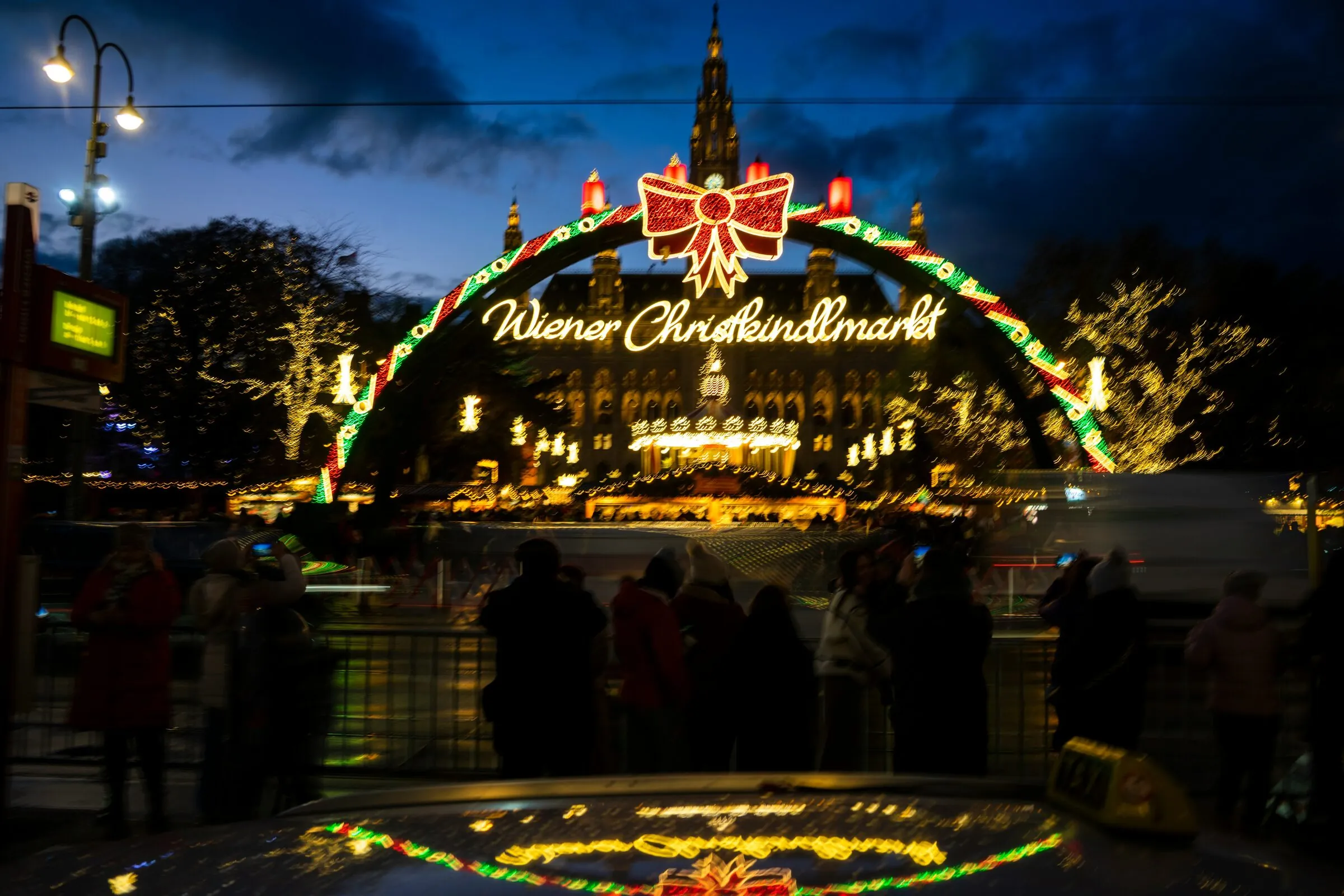
Vienna delivers everything you expect and then some. The Christmas markets here are refined and polished — more upscale in feel than the German markets downstream, with vendors who take the craft seriously. The Rathausplatz market, set against the illuminated Neo-Gothic City Hall, is genuinely magical on a clear cold night. The Schönbrunn Palace market is slightly less crowded and worth the short trip if you have time.
AmaWaterways’ included excursion covers the Imperial highlights well, but I’d carve out independent time to walk the Naschmarkt (even in November it’s operating) and to find your way to the Judenplatz Holocaust Memorial — Rachel Whiteread’s concrete inverted library, sitting quietly in a square that has been Jewish Vienna’s center since the Middle Ages. It doesn’t announce itself. You have to look for it. It rewards the looking.
Insider tip on the markets: Vienna’s vendors tend toward fine foods, handmade glass ornaments, and Austrian craft spirits. Budget accordingly. And buy the thing you’re considering. I walked past a hand-thrown ceramic bowl and told myself I’d circle back. I didn’t. I still think about it.
Melk
I wasn’t fully prepared for Melk. The Melk Abbey — a Benedictine monastery perched dramatically above the river on a rocky promontory — is one of the most stunning Baroque structures I’ve encountered anywhere in Europe. The interior is jaw-dropping: gilded altars, sweeping frescoes, and a library that looks like it was designed specifically to make people believe in something. If you have any inclination toward architecture or art history, give this everything you’ve got. It was the artistic and cultural centerpiece of the entire trip.
The descent back to the ship through the old town is lovely. Stop for an Apfelstrudel if time permits.
Passau
A beautiful three-river town where the Inn, Ilz, and Danube converge — the visual effect of different-colored waters meeting is genuinely striking. The old town is compact and entirely walkable, and the Christmas market here has a distinctly neighborhood feel. Less touristic than Vienna or Nuremberg, which is its appeal.
Insider tip: St. Stephen’s Cathedral contains one of the largest pipe organs in the world. If there’s an afternoon recital during your visit, go.

Regensburg
My personal favorite of the entire route. Regensburg is charming in a way that feels completely unperformed — the city isn’t trying to impress you, and that’s precisely why it does. The medieval old town is a UNESCO World Heritage Site, and the Christmas market wraps through its cobblestone streets in a way that feels genuinely embedded in the place rather than dropped on top of it.
Buy your ornament here. Buy your Glühwein here. Buy the bratwurst from the Historische Wurstkuchl — a sausage kitchen that has operated continuously since the 12th century, which remains a remarkable sentence to type — and eat it on the steps by the river. This is the market where the experience clicks into place.
Insider tip: The walk across the Stone Bridge at night, with the cathedral lit up behind you and the river below, is one of the better views on the entire itinerary. Don’t miss it.

Nuremberg
I disembarked in Nuremberg and spent the full day in the city before flying home that evening — which I’d strongly recommend over heading straight to the airport.
Nuremberg’s Christkindlesmarkt is the most famous Christmas market in Germany, dating to the 1600s. The Hauptmarkt setting is undeniably impressive, and the market has its own civic ceremonial character that sets it apart from all the others. It’s larger, busier, and yes — more commercial. But you feel the history of the thing.
What I wasn’t entirely prepared for was the weight of Nuremberg’s other history. The Nazi Party Rally Grounds and the adjacent Documentation Center are essential visits for any serious traveler. The Documentation Center is one of the most thoughtfully constructed historical museums I’ve encountered — it doesn’t let you look away, but it also doesn’t exploit. And scattered through the old city are memorials to the communities Nuremberg lost — plaques, stumbling stones set into the pavement, a small LGBTQ+ memorial that sits quietly near the medieval walls. The city has chosen to remember rather than move past, and that decision is visible everywhere.
There’s a particular dissonance in eating a Nuremberg bratwurst (three on a roll, the traditional way) in the shadow of all of this history. I didn’t resolve it. I just sat with it.
Insider tip: Google Translate earns its keep here again — German market signage gets dense and specific in ways that matter when you’re trying to figure out what’s actually in what you’re eating.
Traveling Solo on AmaWaterways: What to Actually Expect
Solo travel on a river cruise is a genuinely different experience than solo land travel, and I want to be honest about both sides.
The passenger mix on a holiday markets cruise skews toward couples and families, and in general the river cruise crowd skews older. There were moments where being the only one at a table for two was noticeable. But “noticeable” isn’t the same as “awkward,” and AmaWaterways handled the solo experience thoughtfully. Staff were clearly intentional about seating — I was consistently placed near people I ended up genuinely enjoying, and by day three I had a loose circle of dinner companions and market wanderers.
The ship’s size is a significant factor here. At roughly 160 passengers, you organically cross paths with the same people repeatedly. Relationships form naturally because the vessel is small enough that everyone becomes familiar. I’m naturally open to sharing meals with strangers, which helps — but even if you’re more introverted, the communal rhythm of a river cruise tends to draw people out.
The Chef’s Table, in particular, is a perfect environment for solo travelers. The shared experience creates connection in a way that feels organic, not engineered.
Bottom line: AmaWaterways is not marketed as a solo product. But they handle it with more grace than most. If you’re comfortable in your own company and genuinely open to new people, you will have a wonderful time.
Before You Go / When You Return: Extend the Journey
Before: Budapest (add 2–3 nights) As discussed at length above — thermal baths, ruin bars, the market hall, the riverbank memorials, the food. Budapest deserves its own trip. Treat it as one.
After: Prague (add 2–3 nights) If you’re already in Central Europe in late November or December, Prague is an obvious and spectacular extension. The Christmas markets at Old Town Square and Wenceslas Square rival anything on the cruise route, and Prague’s medieval architecture at night — especially in the snow, if you’re lucky — is among the most dramatic urban experiences in Europe. Fly or take the train from Nuremberg; it’s an easy connection. Don’t miss the Josefov quarter, Prague’s former Jewish neighborhood, which contains some of the most significant preserved Jewish history in Central Europe. The Old Jewish Cemetery alone is worth the trip.
Is AmaWaterways Worth the Premium Price?
Yes. And I say that as someone who evaluates travel value for a living.
The pricing sits firmly in the luxury tier — this is not a budget river cruise. But what you’re getting in return is substantial:
• All excursions included every port, with quality local guides who make the history feel alive
• Wine, beer, and soft drinks with every meal, regionally sourced and thoughtfully chosen
• Sunset cocktail hour every evening
• Immersive dining experiences — Chef’s Table, Captain’s Table
• Local entertainment and cultural performers brought on board at select ports
• Active and gentle excursion options at every stop
• Service that anticipates rather than just responds
When you add up what’s included versus what you’d pay à la carte on a less comprehensive cruise, the gap closes considerably. And the intangibles — the caliber of service, the intimacy of the ship, the access — don’t have direct equivalents at lower price points.
Who Is This Trip For?
This itinerary — holiday markets over Thanksgiving week — is ideal for:
• Solo travelers who want structure without rigidity and genuine human connection
• Couples looking for a romantic, culturally rich alternative to a traditional Thanksgiving
• Anyone with “European Christmas markets” on their bucket list who wants to experience them properly, not on a rushed bus tour
• History-minded travelers for whom Central Europe’s layered past — beautiful and difficult in equal measure — is part of the draw
• First-time river cruisers who want to understand why the format inspires the loyalty it does
It is probably not the right fit for travelers who want beach weather, high-energy nightlife, or thrill-seeking. This is slow, beautiful, culturally immersive travel. That is entirely the point.
Ready to Plan Your Own Danube Christmas Market Cruise?
The best cabins and departures for the 2026 holiday season are already filling. If this itinerary resonates — whether you’re planning a solo escape, a romantic trip, or a group gathering — I’d love to help you put it together.
I have firsthand experience with AmaWaterways and direct access to their full inventory, including suite upgrades, exclusive amenities, and flexible payment options you won’t find booking directly.
Plan your trip with me.
A 30-minute discovery call is where it starts. No fee, no pressure.
Book a Discovery Call